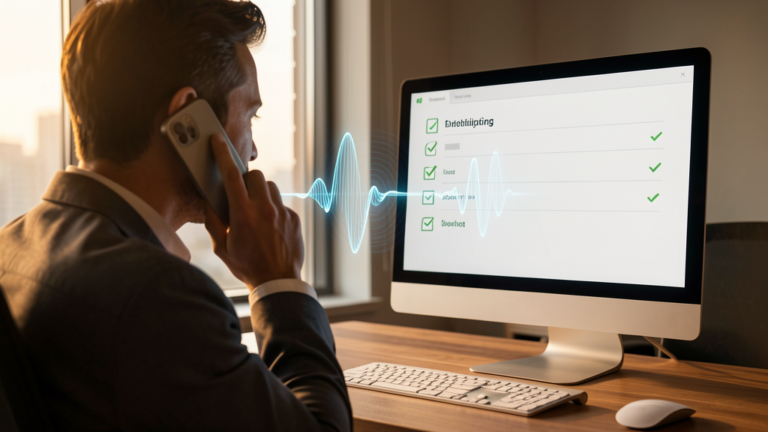

Voice AI is useful when something happens after the talking
Voice AI has spent years being a party trick.
A very polished party trick, granted. It could answer questions, sound friendly, interrupt slightly less awkwardly than before, and make demo audiences do that little impressed nod. Lovely. Still not enough to run a business process.
The practical shift is voice plus tools.
smol.ai's roundup on GPT-Realtime-2 points to better realtime voice, interruption handling, tool use, larger context, streaming translation, transcription, and browser-control movement around Codex. The details will keep changing, because AI product naming is apparently a competitive sport now. The direction is what matters: voice is becoming an interface for action, not just conversation.
Talking is not the product
A receptionist who only talks is not a receptionist. A good receptionist routes, records, checks, books, follows up, and knows when to interrupt a human.
Same with voice AI.
If a customer calls and the assistant can answer a question but cannot create a booking, update the CRM, send the quote, check the order, or escalate the issue, you have a speaking FAQ. Better than nothing. Not exactly thrilling.
A useful voice agent needs to do the boring after-work:
- capture the request
- check the right system
- ask for missing details
- trigger the next step
- log what happened
- hand off cleanly when the task is risky or emotional
That is where the money is.
Where this fits first
Voice agents will not replace every front desk or support desk overnight. Good. Businesses have enough chaos without adding a talking mystery box to the phones.
The smart first use cases are contained and repeatable: appointment changes, job status checks, intake questions, internal help desk requests, meeting follow-ups, simple order checks, and call summaries.
The agent should be useful even when it does not complete the whole task. A clean summary, a routed ticket, a drafted response, or a checked record can save real time.
That is the unglamorous truth of automation. Half the value is not replacing the person. It is removing the sludge around the person.
The workflow still needs manners
A voice agent should not behave like a caffeinated intern with admin access. It needs rules. Which requests can it complete alone? Which ones need confirmation? When does it stop talking and get a human? What does it write back into the system after the call?
That last bit matters more than people think. If the voice assistant handles a call but leaves no record, the business has gained a nice conversation and lost the plot. The log is part of the product. So is the escalation path. So is the ability to say, clearly, "I cannot do that, but I can send this to the right person."
Useful voice AI will feel less like a talking novelty and more like a disciplined front-desk operator who happens to be available at weird hours. Which is rude, frankly. Some of us enjoy sleeping.
The business takeaway
Voice AI becomes useful when it is connected to tools, memory, and rules. Otherwise it is just a charming mouth with nowhere to put the work.
For Agent V8 customers, the opportunity is not "let's add voice because it sounds futuristic." The opportunity is to find repeat conversations that should trigger repeat actions.
If the assistant can listen, act, log, and escalate, now we are talking.
Finally.
Sources
- smol.ai, "GPT-Realtime-2, Translate, and Whisper": https://news.smol.ai/issues/26-05-07-gpt-realtime-2/